- Energize Framingham
- Posts
- December 2025
December 2025
Your latest local news on sustainability and climate change action
Subscribe and never miss an issue!
IN THIS ISSUE
Like what we do? Consider a year-end donation!
High energy bills? Help is available
New City Charter passes, with a new Chief Climate Officer
Energize partners with middle schoolers on trees
Specialized Building Code vote set for Dec. 2
New CPC grants in the pipeline
Revamped Logan Express terminal sports solar panels
Share your experience with energy upgrades
Upcoming events | In the news

High energy bills? Help is available
The nonprofit All in Energy is offering Energy Bill Check Ups in partnership with the city of Framingham. If you run into them at events or knocking on your door, they’re legit and might be able to find ways to trim your costs.

Their team will review your energy bills, make sure you’re not getting scammed by your current supplier, make sure you have the lowest rate available to you, and connect you with programs like Mass Save that can reduce your energy costs.
Learn more at BillCheckUp.org or call (857) 309-5080 to schedule a bill checkup.
New City Charter passes — with a new Chief Climate and Sustainability Officer!
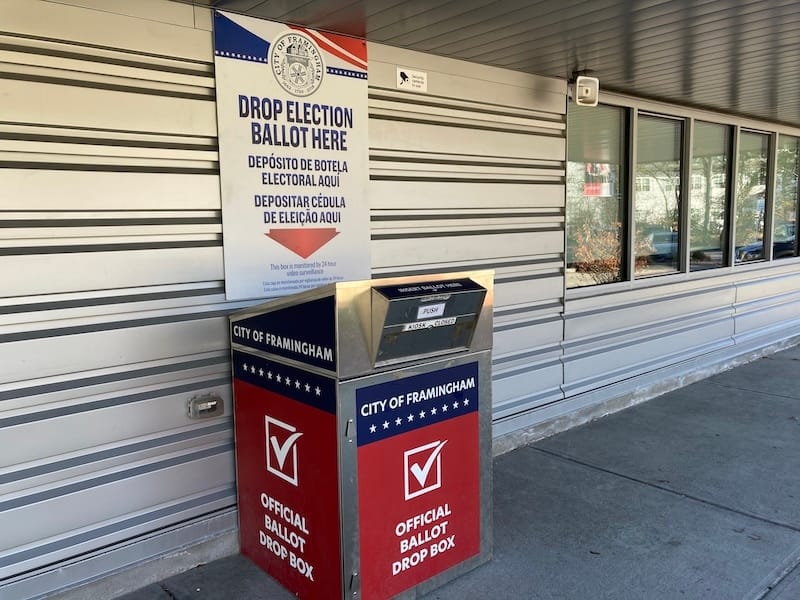
The November 4 ballot question on changes to Framingham's City Charter passed by a wide margin — 7,138 to 2,051. Thanks to all who helped raise the visibility of this ballot question! The path is now cleared to add a Chief Climate and Sustainability Officer to Framingham’s government. This exciting development would provide for executive-level leadership empowered to work across all departments and develop a climate and sustainability framework for the city.
Energize Framingham began to push for this position at the end of 2023. After some initial skepticism, the Charter Review Committee added it to the proposed charter changes, and in August 2024, the City Council voted 9-2 to include it. (Voting yes, Councilors Phillip Ottaviani, Leora Mallach, Janet Leombruno, Adam Steiner, Christine Long, Brandon Ward, George King, Tracey Bryant, and Leslie White Harvey; voting no, Councilors Michael Cannon and Noval Alexander.)
However, while the Charter has passed, the new job isn’t created automatically. The Mayor’s office needs to submit a salary and job description in its next budget request, and the City Council needs to approve it. At our recent Candidates Climate Forum, Mayor Sisitsky (now reelected), expressed support for the position and said he intends to have the officer report directly to him. Energize Framingham hopes to be involved!
New budget process allows more citizen input
Also relevant to climate and sustainability in Framingham, the Charter adjusts the budgeting process, giving more time for the community to weigh in and more time for the City Council to review the proposed budget.
On November 18, the Mayor told the City Council that the charter requires an initial budget meeting to include the City Council, School Committee, Superintendent of Schools, and the Strategic Initiatives and Financial Oversight Committee (SIFOC). He said this meeting would need to happen before the end of 2025, followed by a public hearing on the operating budget, likely in February (possibly Monday February 23). The operating budget would then need to be submitted to the City Council by March 1, 2026, earlier than before.
As for the capital improvement budget, the CIty Council would be required to hold a public hearing and adopt the budget by February 27, 2026 (previously it was June). This would allow capital projects to be put out to bid sooner.
The School Committee is now required to submit its operating budget to the Mayor by February 8, 2026, also after a prior public hearing.
Energize partners with middle school students on tree planting
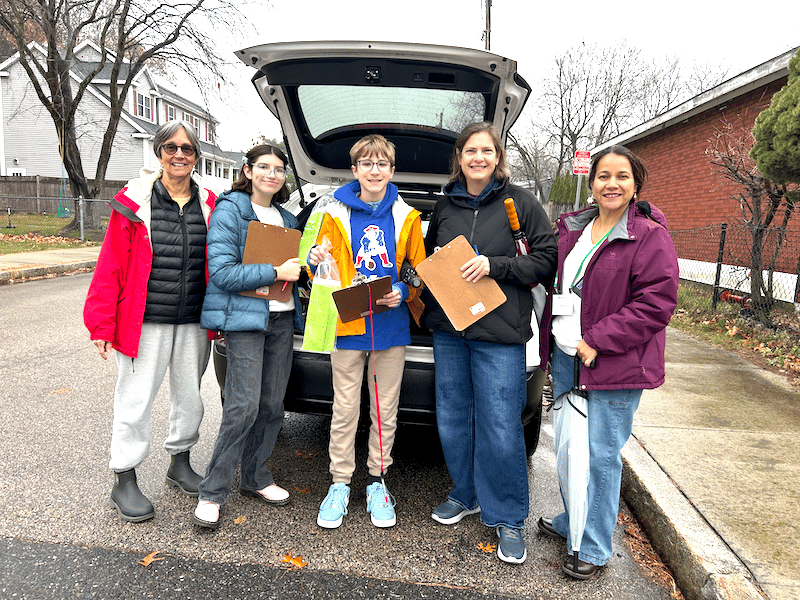
Energize Framingham is partnering with SAGE programs at the Walsh, Cameron, and Fuller middle schools to help cool a south side neighborhood through tree planting. On November 22, seventh- and eighth-grade students, accompanied by teachers and parents, distributed information packets in English, Portuguese, and Spanish to about 70 houses. The packets held flyers inviting residents to have trees planted on their property through the city’s setback tree planting program. Energize Framingham’s Nanette Magnani and Liliane Dutra assisted the effort, led by SAGE teacher Anne Doucet.
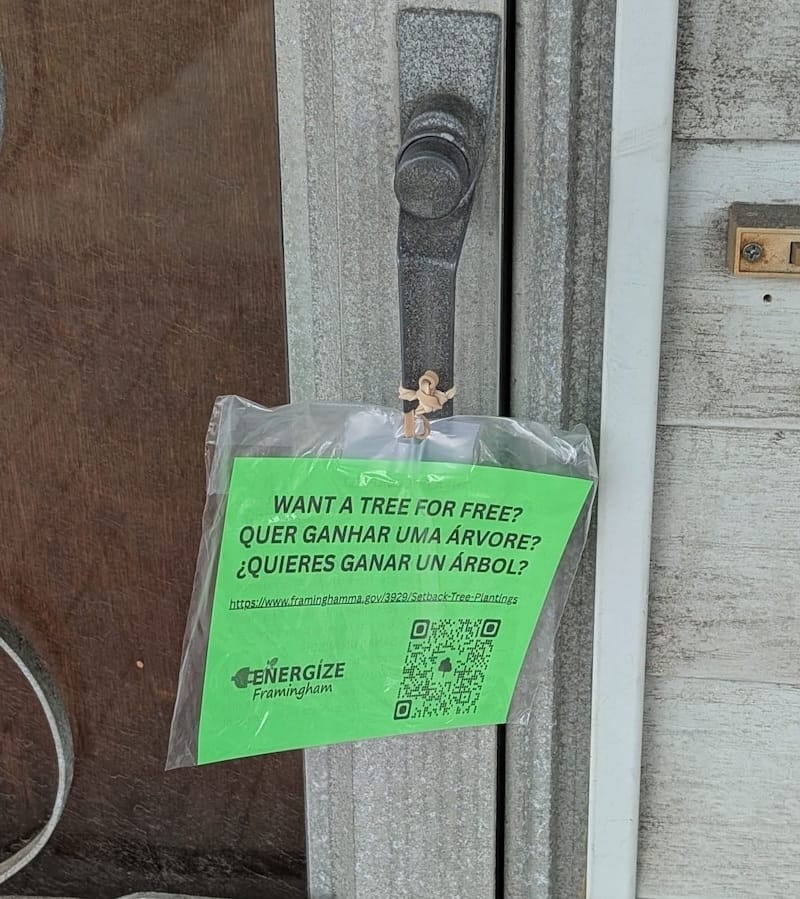
The students chose a neighborhood roughly bounded by Waverly Street (Route 135), St. Tarcisius Cemetery, Winthrop Street, and Cedar Swamp to receive the packets. They drew on heat mapping data gathered by Framingham State University, flagging a neighborhood that tends to be hotter in summer and is walkable and densely populated.
Irving Street action
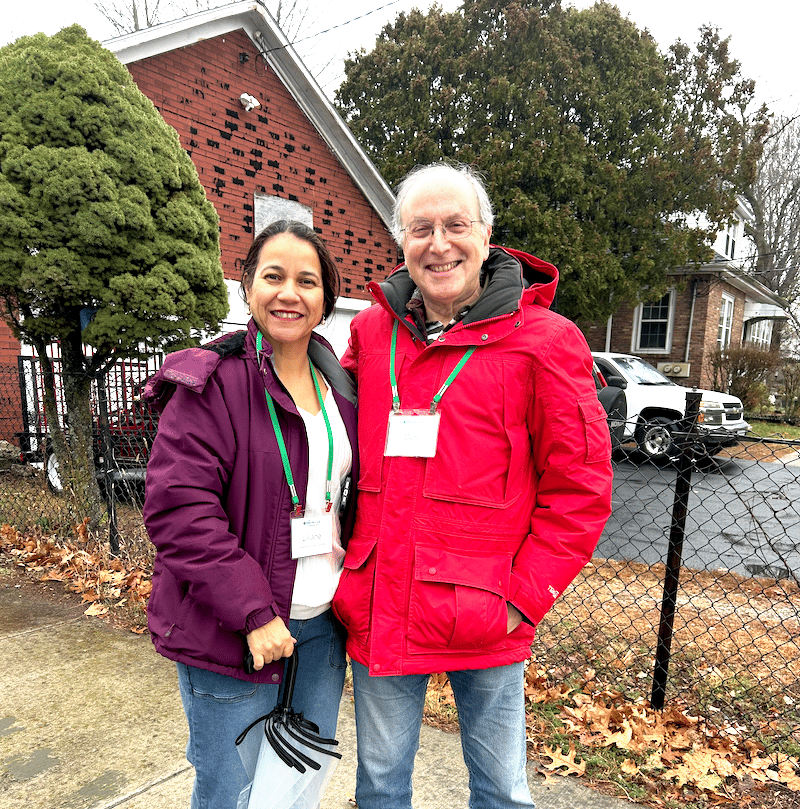
Energize Framingham’s Street Tree Group also distributed flyers to nine previously identified properties on Irving Street. Dan Schullman and Liliane Dutra followed up with visits to the residents on November 22.
Energize Framingham will use the results of these projects to help plan similar efforts in other heat-island neighborhoods.
Specialized Code gains more support from city councilors; vote coming Dec. 2
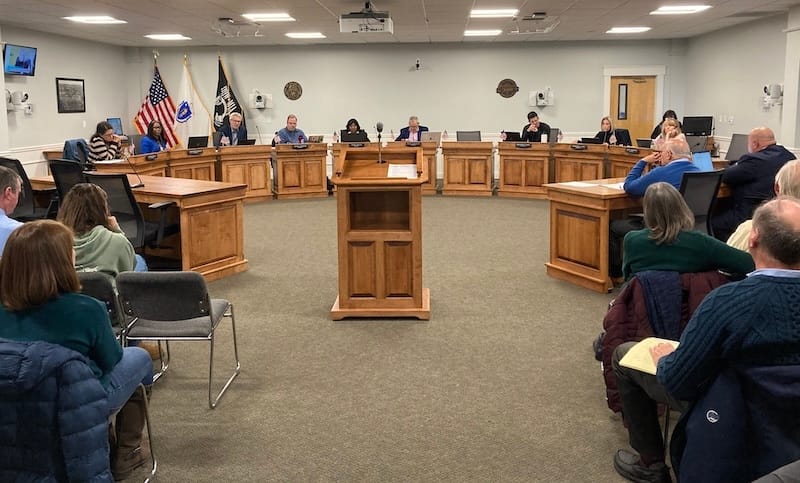
After much public comment at the November 18 City Council meeting, the Council voted 9-2 to close the hearing on adoption of the Specialized Building Code. (Councilors Michael Cannon and Christine Long voted “no,” wanting to continue the discussion.)
The vote is now set for December 2.
Among those testifying were Doug Lawrence, chair of the Framingham Democratic Committee, who reiterated the Committee’s support of the code, cited the state funding Framingham would be eligible to receive, and argued that the code provides consumer protection, ensuring that future retrofits would be far less costly.
Erin Ellsworth, chair of the Framingham Sustainability Committee, responded to prior issues raised by some Council members. She noted that added construction costs are typically just 1 to 3 percent for residential buildings and 0 to 2 percent for commercial buildings.
“It costs a little bit more to build and significantly less to live in or operate,” she said.
To the claim that the city would have to accept any amendments to the Specialized Code, Ellsworth noted that this is also true of the existing building code, and that the amendments are not always more restrictive. For example, the state reduced some insulation requirements after builders raised concerns.
“Who do we want shaping the future of Framingham’s buildings?” Ellsworth asked, “individual developers making individual choices, or a policy chosen intentionally by the City Council to lower long-term costs, improve public health, and build a stronger, more resilient Framingham?”
Aimee Powelka, community lead for Energize Framingham, shared new data from Massachusetts Climate Chief Melissa Hoffer, showing that 97 percent of all buildings permitted in last 12 months have electric heat, 87 percent are completely all-electric, and 93 percent of multifamily homes are being permitted as passive houses. “It shows that developers know how to build this,” she said.
Mark Sandeen, a Lexington Selectman and trustee on the board of Lexington’s Affordable Housing Trust, shared Lexington’s experience with the Specialized Code. He emphasized that Lexington is similar to Framingham with regard to affordable housing economics.
“The Specialized Code turns out to be a huge win for affordable housing developers,” he said. “The economics for the developer are excellent because Mass Save provides over $4,000 per unit for Passive House certification.” He noted that an RFP Lexington issued after the code’s passage drew seven responses, including four highly rated responses.
Councilors Noval Alexander and George King, whose positions hadn’t been known previously, stated that they would support the Specialized Code, suggesting there may be sufficient votes to pass it. (Councilors Brandon Ward, Leora Mallach, Adam Steiner, Leslie White Harvey, and Tracey Bryant stated their support previously.)
Seeking to prevent a vote, Councilor Cannon pointed out that the specific language of the motion to adopt the code hadn’t been shared with councilors in advance. The City Solicitor, reading from the City Charter, confirmed that a single councilor could postpone a vote, but only once. On this technicality, Council Chair Phillip Ottaviani said that the vote would be held at the Council’s next meeting on December 2, and that it would be at the top of the agenda.
There’s still time to act
Dear readers, if you want to see the code passed, please be present at that meeting if you’re able! If you haven’t yet written to your city councilor, it’s not too late!
Don’t forget the two at-large city councilors in addition to your district councilor: George King and Janet Leombruno.
Nothing is guaranteed and it’s important to show the community is watching. Fingers crossed that December 2 will be the day this long saga ends.
You can view the Nov. 18 hearing here (begins at 26:40).
New CPC grants enter the pipeline
In 2020, adopted the Community Preservation Act (CPA), which uses local property tax surcharges (averaging $50 per residence per year) with a match from the state to fund city projects, including projects related to open space and outdoor recreation.
This year, the Community Preservation Committee (CPC) received 24 project eligibility forms, the first step in the project submission process.
Ultimately, 15 projects received initial approval in September and October and submitted full applications by the November 17 deadline. They included the following open space/outdoor recreation projects:
Farm Pond floating dock

This $100,000 project would cover the design of a floating boardwalk on Farm Pond, originally proposed by Ron Chick and originally rejected by the CPC in April. Now deemed eligible for consideration, the boardwalk (shown in yellow) would complete a roughly two-mile loop around the pond and is supported by several City Councilors. (See background in our April 2025 issue.)
43-45 Nixon Road - Ford Estate
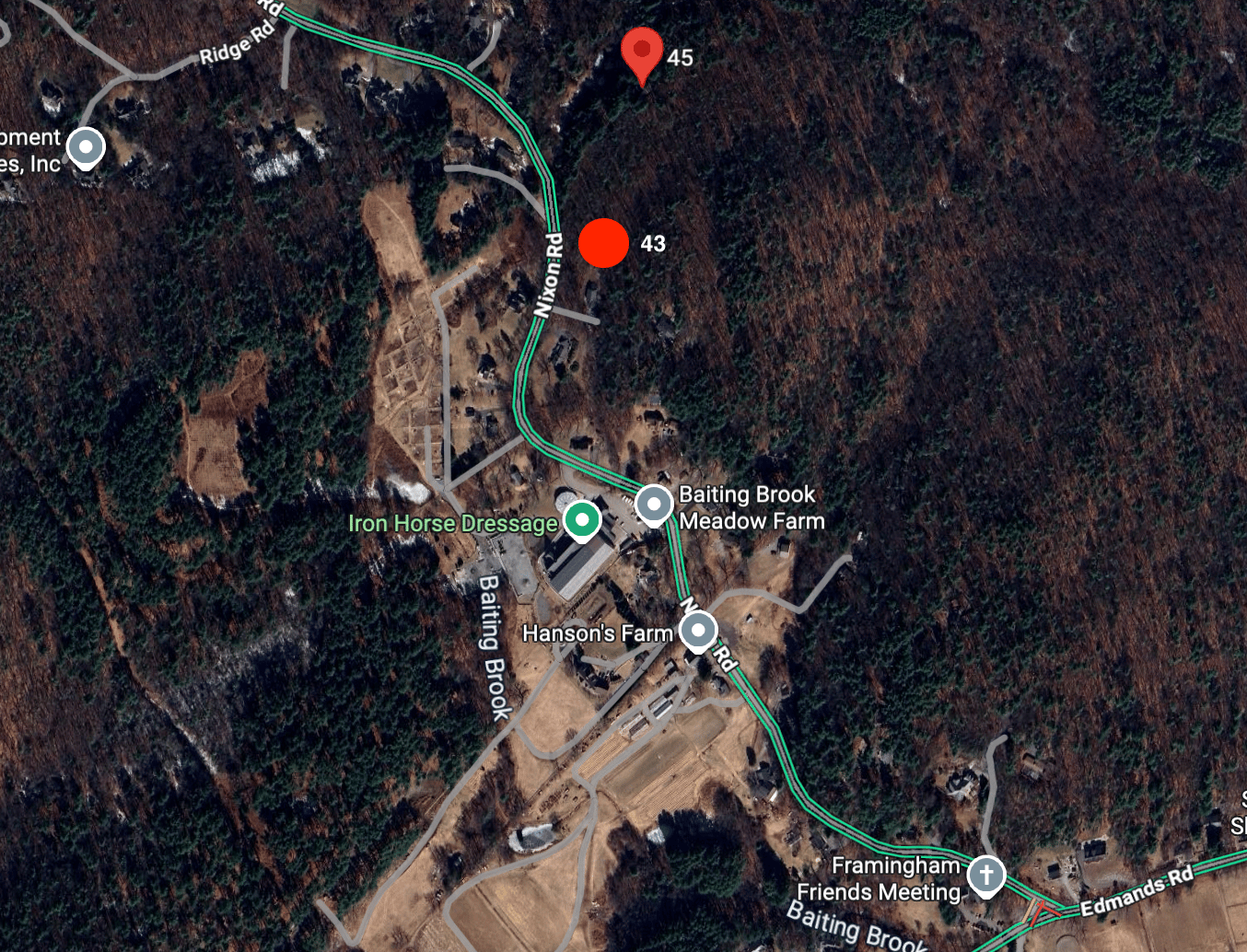
This $250,000 project, originally submitted in 2023, would acquire a conservation restriction on properties at 43-45 Nixon Road in northwest Framingham to create trails connected to the Bay Circuit Trail. This project was submitted by Sarkis Sarkisian, director of Planning and Community Development.
Construction of the middle section of the Carol Getchell Nature Trail
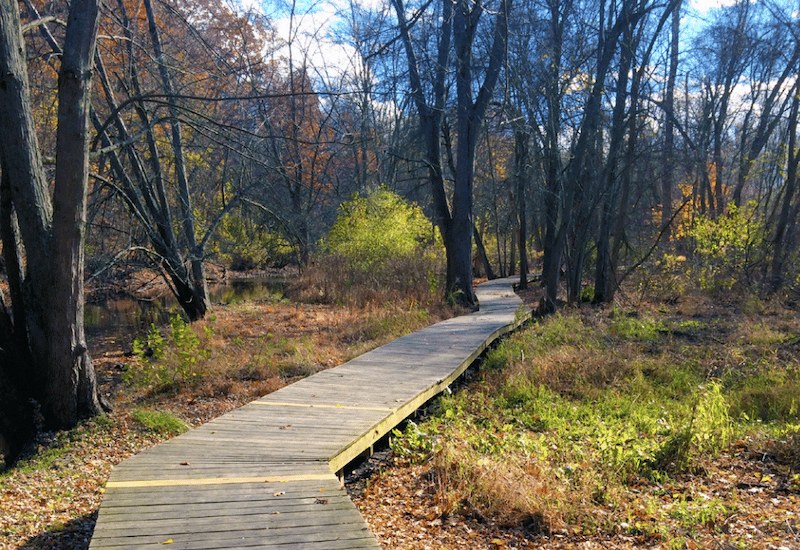
Source: City of Framingham
This $315,000 funding request, submitted by Conservation Administrator Rebecca Nau, would help complete this accessible trail along the Sudbury River. The state was awarded $100,000 MassTrails grant in October.
Waushakum Beach improvements engineering design
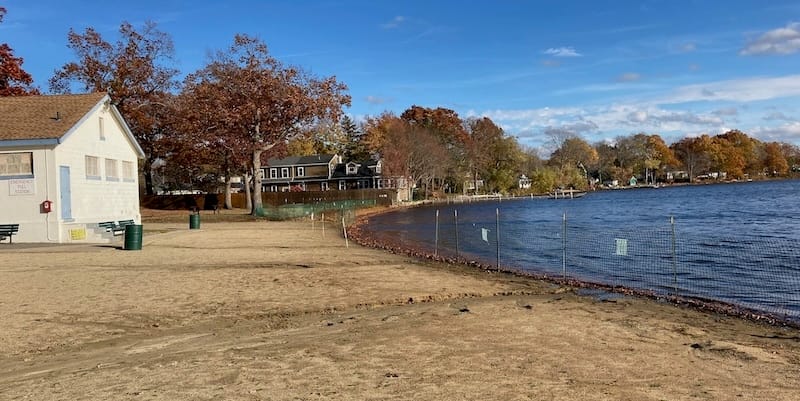
This $300,000 project would include feasibility, structural, and geotechnical analysis and preparation of construction documents for Waushakum Beach. It was submitted by Jim Snyder, director of Parks and Recreation.
Eastleigh Farm preservation

This $3,000,000 project, proposed by Sarkis Sarkisian, director of Planning & Community Development, would permanently preserve 112 acres of farm land at Eastleigh Farm, either through acquisition or an agricultural or conservation restriction.
Concept design for access to Simpson Park
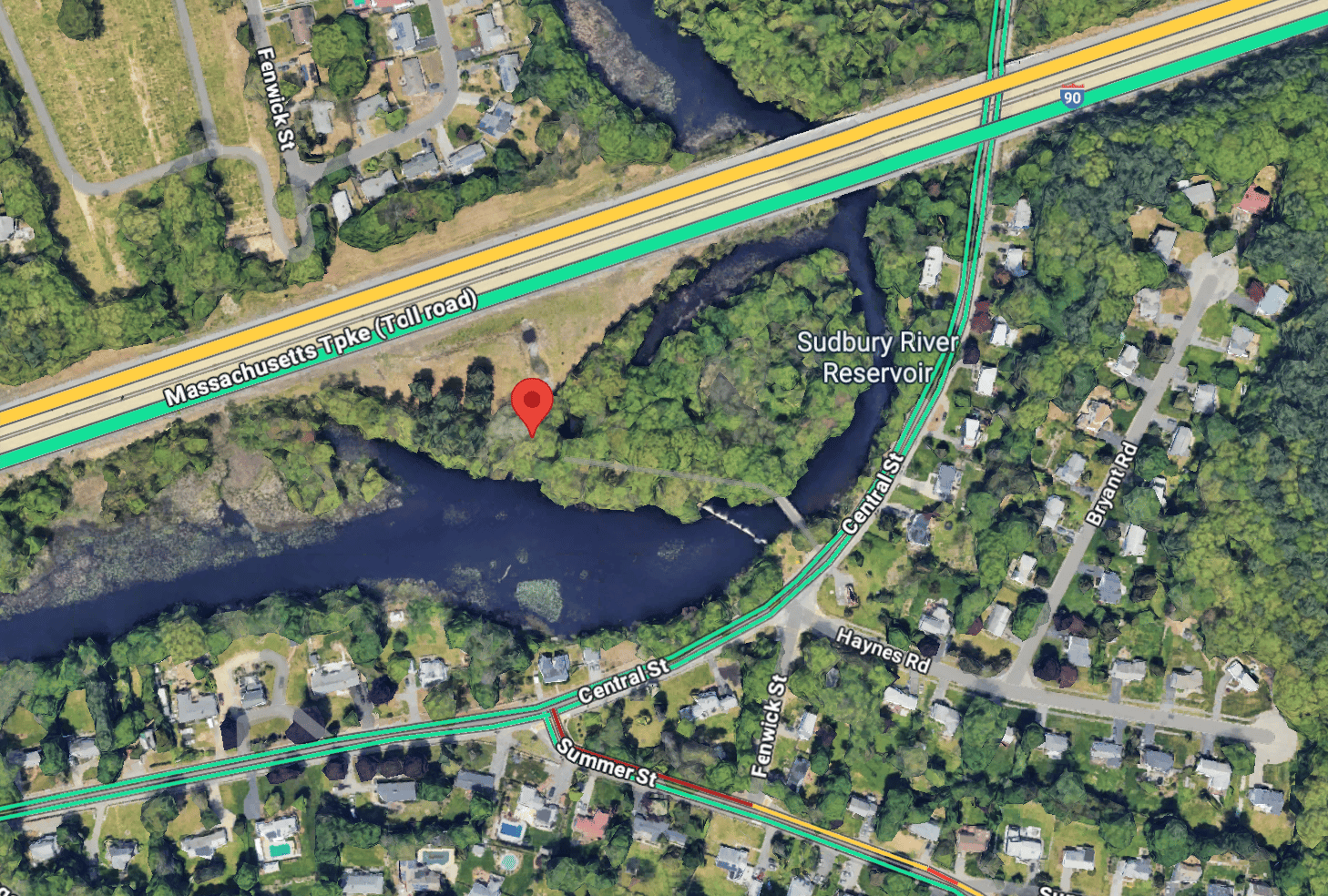
This $50,000 project, also proposed by Sarkisian, would create a design concept plan of the proposed parking area and pedestrian access to the bridge to Simpson Park, located off of Central Street. The City has acquired this property.
ADA water bottle fountain and filler for Anna Murphy Park
This $15,000 project was submitted by Liz Kaprelian of Friends of Waushakum Beach.
Next steps
The CPC is now beginning to review the full applications and meet with applicants. The approved projects will advance to the City Council in 2026.
Several additional projects were submitted initially but did not submit a full application in time for the November 17 cutoff:
Feasibility study for a new community farm at 55 Bethany Road
Enhancements to the Cochituate Brook Reservation
Rehabilitation and repair of the Cochituate Rail Trail Corridor to eliminate invasive and poisonous plants along the trail.
Design study for the Oxbow Trail on the Sudbury River
BRIEFS
A revamped Logan Express building, with first-in-U.S. solar panels
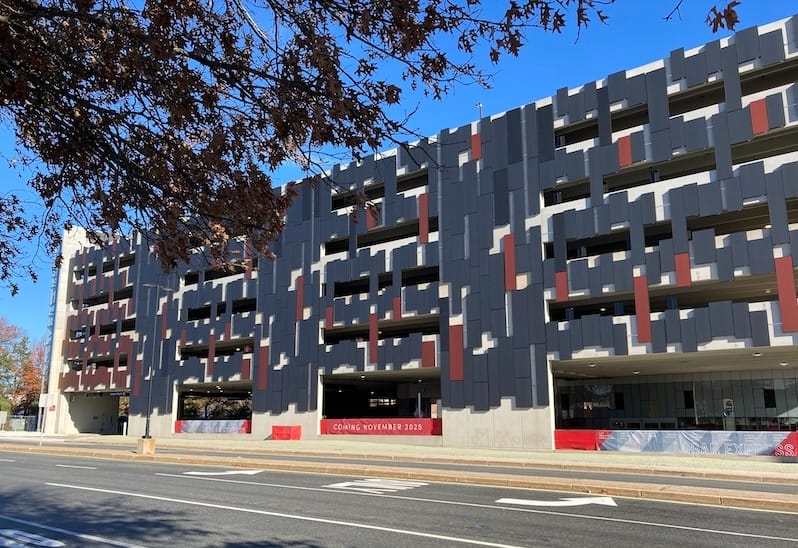
Framingham’s new Logan Express building, now open, features not just more parking, but electric vehicle chargers and 2,658 photovoltaic panels on its exterior, providing 50 percent of the building’s energy.
Not merely decorative, the panels you see here are the first of their kind to be installed in the U.S., according to Massport, which is seeking ParkSmart Silver Certification for sustainable parking design.
Have you made clean energy upgrades to your apartment, condo, or rental property? The City of Framingham, as well as the towns of Natick and Ashland, want to hear from you!
If you live in or own an apartment, condo, or multi-family property, you are invited to share your experience with energy efficiency improvements, and what helps or hinders in making these upgrades. Improvements could include insulation, high efficiency appliances, efficient heating and cooling equipment, heat pumps, solar panels, and more.
Your input will help shape future clean energy programs in Framingham. If interested, please contact the project team at the MetroWest Climate Equity ProjecInitiative at [email protected] or 617-933-0772. If selected, you’ll be invited to participate in a 1- to 2-hour discussion, for which you’ll receive a $100 gift card.
UPCOMING EVENTS
Stay updated about events by visiting www.energizeframingham.org/events. You can sign up for email notifications by creating a profile (“Sign In/Join” button on the top right corner on the page).
Wed., Dec. 3, 7:30-8:30 p.m. Your Yard, Our Climate
Think globally, plant locally! Trevor Smith of ReEarth Studio Social Impact Collective will give a fresh picture of global warming in a program that will leave you inspired to think native species for spring planting. Free and open to the public. Sponsored by Congregation Or Atid’s Etz Hayim Climate Action Committee. Register for Zoom link.
Dec. 31, 2025: NYE on the CRT
Spend a magical evening on the Cochituate Rail Trail and stop by our table, where our wonderful partner Zippity Do Dog is kindly hosting hot chocolate. The evening is hosted by Friends of Framingham Trails.
Framingham
Will Framingham adopt special energy code for builders? What to know (MetroWest Daily News)
Ed. note: This article unfortunately quotes Councilor Christine Long’s incorrect concern about home remodeling costs (the Specialized Building Code does not apply to home remodeling) and attributes the decision to delay the vote to the full City Council, rather than to Councilor Cannon, who alone requested it.
181-unit mixed-use project breaks ground near Framingham rail stop. What to know (MetroWest Daily News)
The story cites 358 Waverly Street in downtown Framingham.
Massport reopens expanded Logan Express in Framingham MA (MetroWest Daily News)
The new terminal features 2,658 photovoltaic panels which provide half of its energy, as well as 1,000 new parking spaces.
Updates Provided on Framingham’s Bruce Freeman Rail Trail Extension (The Frame / Access Framingham)
The first phase of construction into Framingham should hopefully begin in 2029.
Massachusetts/Region
STATEHOUSE UPDATE:
House punts on sweeping energy bill that would dial back state climate commitments (CommonWealth Beacon)
To the relief of advocates, the Massachusetts House is postponing debate on an energy policy bill (detailed in the next item) that would weaken the state’s 2030 climate goals. Opposition by multiple groups — the Massachusetts Climate Action Network, ZeroCarbonMA, and many others — led to the postponement, until after the Legislature’s extended holiday break.
Sweeping energy bill to weaken 2030 climate goals clears key House committee (CommonWealth Beacon)
A Massachusetts House committee advanced a major bill, H.4744, that could scale back the state’s efforts to fight climate change and make its 2030 climate mandate unenforceable, in the name of energy affordability. The bill would cut $500 million from the Mass Save program and roll back the amount of renewable energy that utilities are required to purchase.
Industry lobbying appears to have played a role: The bill’s sponsor, Braintree State Rep. Mark Cusack, received a reported $4,100 in donations on the day of the committee vote, mostly from energy lobbyists.
Advocates are pushing back on the claim that climate policies are the thing making energy prices rise, as energy supply and gas infrastructure investments have been the main cost drivers. The Acadia Center argues that the bill’s passage would exacerbate the current affordability crisis through increased fossil fuel volatility. More coverage in the Boston Globe and Canary Media.
Why Mass. gas bills are rising — and what we need to do about it (Boston Globe)
This opinion piece, by the former chair of the Massachusetts Department of Public Utilities, argues that most of what customers now pay no longer goes toward fuel, but toward rebuilding and maintaining a gas network that is larger than necessary to meet future needs.
Nine Massachusetts Towns Earn 'Climate Leader' Status, Eye $3.7M in Sustainability Grants (Hoodline)
Aquinnah, Bedford, Harvard, Lincoln, Needham, Stockbridge, West Tisbury, Weston, and Winchester can now apply for part of $3.7 million in grants to support municipal emission reduction projects. An additional $3.7 million in Decarbonization Accelerator Grants will go to Acton, Ashfield, Chelmsford, and Watertown for larger projects, including a fully decarbonized town hall in Acton and a solar-powered wastewater plant in Ashfield.
Municipalities warn Beacon Hill they’ll need to slow down solar projects due to state limit (CommonWealth Beacon)
Under net-metering, municipalities that install solar panels on rooftops, parks, and parking lots can receive an electric bill credit for any excess power they send to the power grid. But now, some towns and cities are running into local and regional caps that Massachusetts enacted over a decade ago that limit how much solar energy municipalities can net-meter. Solar officials and advocates are urging lawmakers to eliminate the caps, which are an impediment to expansion of solar.
Massachusetts considers expanding effort to ban gas in new buildings (Canary Media)
Lawmakers are weighing a bill that would allow 10 more cities and towns to prohibit the use of fossil fuels in new construction through an existing pilot program. Salem and Somerville are lining up to participate, and Boston and Worcester are also interested.
Dirty water, indeed: New proposal would allow continued sewage in the Charles (Boston Globe)
There’s been great progress in cleaning up the Charles River over the decades, but state officials overseeing water and sewer services for much of Massachusetts are proposing an about-face, allowing some sewage releases into the river merely by changing the water quality classification of the Charles.
Trump is skipping the UN’s climate conference. Some New Englanders are filling the void. (Boston Globe)
Can Mamdani supercharge New York’s clean energy revolution? (Grist)
Can New York’s new mayor keep his promises on public renewables?
National/General interest
Five ways heat pumps are more awesome than you think (Project Drawdown)
U.N. climate talks end without agreement on phasing out fossil fuels (NPR)
In the end, the COP30 conference delivered only modest progress on international efforts to curb global warming and pay for the costs of adapting to a hotter planet.
EPA just approved new ‘forever chemical’ pesticides for use on food (Boston Globe)
The Environmental Protection Agency is moving forward with approvals for pesticides containing PFAS (“forever chemicals”) as an active ingredient, dismissing concerns about health and environmental impacts.
ABOUT US
Energize Framingham provides climate education, outreach, and advocacy to promote a healthy, equitable, and resilient community.
Have a tip for us? Email [email protected].
In case you missed it… Back issues!
Editors: Nancy Fliesler and Aimee Powelka
