- Energize Framingham
- Posts
- January 2026
January 2026

Your latest local news on sustainability and climate change action
Subscribe and never miss an issue!
IN THIS ISSUE
10 sustainability wins in 2025
Framingham Sustainability Committee’s 2026 recommendations to the Mayor
Geothermal network set to expand
City Council to take up gas-powered yard equipment
Check out the Home Modernization Navigator
Time-limited: 20% off Black Earth Compost subscriptions
Cafeteria composting at Potter Road – call for volunteers
Framingham gets another air monitoring station
Internship opportunity at Mass Energize
Upcoming events | In the news
Framingham’s sustainability wins in 2025

In a year where climate action essentially died at the federal level, local climate action is still alive and still making an impact! In 2025, Framingham showed how it’s done. Here are 10 big sustainability wins for the city:
1. Paving the way for a Chief Climate and Sustainability Officer
In November, citizens of Framingham voted overwhelmingly for the new City Charter, which establishes a new executive-level climate officer in our city government, empowered to work across all departments. Now we need to hire the right candidate. The Framingham Sustainability Committee has asked the Mayor to include a salary for the position in the next city budget. Energize Framingham seconds that request!
2. Passage of the Specialized Building Code
One of the City Council’s final acts in December was to pass a new building code that ensures that all new construction in Framingham will either be fossil-fuel-free or pre-wired for easy conversion to all-electric heating and cooling in the future. This is a big win for building owners, individual homeowners, and renters, who will enjoy lower energy costs and healthier indoor air. It’s also a positive local step for the climate, as 70 percent of planet-warming carbon emissions in Framingham come from buildings.
3. Geothermal network gets federal funding to expand
Framingham continues to lead in renewable energy innovation, with approval in December to double the size of our existing geothermal loop with an $8.6 million federal grant. Despite cuts to many other renewable energy programs, the Trump administration appears to be embracing geothermal technology, with a new Geothermal Technologies Office in the Department of Energy. See item below for more on the expansion.
4. Launch of Framingham Community Electricity
In March, after a lengthy process, the city launched a group electricity buying program for Framingham residents and businesses. The program is providing stable electricity rates and the option to purchase more electricity from renewable sources. During its first four months, electricity customers collectively saved more than $268,000 as compared with Eversource Basic Service. The vast majority of customers stuck with the default option, Framingham Standard Green, which provides 35 percent of its electricity from renewable sources. It’s easy to choose a different option (or resume Eversource Basic Service) by filling out this form.
5. Curbside composting expansion
A years-long campaign to boost food waste composting paid off in 2025. In August, the City of Framingham began providing each new subscriber to Black Earth Compost, our curbside food waste collector, with a free bin and roll of liner bags (offer to continue while supplies last). The effort landed more than 100 new subscribers, bringing Framingham’s total to more than 540 composting customers. It’s a win for city finances (reduced landfill tipping fees) and for the climate (reduced methane emissions from landfills). If you don’t yet subscribe, see the Briefs section below for a special offer!
6. Expansion of school cafeteria composting
In 2025, two new schools – Brophy Elementary and Potter Road Elementary – began separating compostable cafeteria food waste from trash and recyclables, joining Dunning Elementary School. Black Earth Compost is doing the pickup and converting the waste into compost that can be used for horticulture and gardening. We hope to see more schools join this year.
7. Progress on tree planting
New trees are in the works for Framingham. To boost the city’s setback tree planting program, Energize Framingham partnered with SAGE programs at the Walsh, Cameron, and Fuller middle schools to educate residents about the program, guided by heat mapping data from Framingham State University. FSU’s data flags neighborhoods that tend to be hotter in summer and would benefit most from tree cover. A second Energize Framingham team met with the Framingham Public Schools to plan tree planting initiatives at schools.
8. Steps toward EV street charging
About 28 percent of Framingham’s greenhouse gas emissions come from cars. The city took a major step in 2025 toward encouraging electric car use by laying the groundwork for curbside charging stations. Through a $500,000 grant from the Massachusetts Clean Energy Center, the city aims to install three to five charging locations with two to five dual-port stations each. Based on consumer feedback, possible sites include City Hall, the Main Library, Butterworth Park, and Waverly Street near the MBTA commuter rail station.
9. Trail upgrades and expansions
Framingham saw progress in funding, design, and/or upgrades for several of its trails: the Carol Getchell trail (completion of its north and south boardwalks announced in late December); the Chris Walsh Memorial Trail at Farm Pond (including a possible floating boardwalk); and the Bruce Freeman Rail Trail. The Cochituate Rail Trail, which just hosted its third successful New Year’s Eve event, received artist applications for art installations on the trail. We look forward to seeing the selected projects!
10. Recognitions for climate leadership
Framingham was recognized in several ways in 2025. Framingham’s Sustainability Coordinator Shawn Luz was recognized as Sustainability Leader of the Year in October by the Northeast Renewable Energy Coalition. Framingham was also one of four municipalities called out by Mass Save and its sponsors for its commitment to implementing energy efficiency upgrades. Framingham High School won silver in an international climate art competition, and Framingham received recognition in the national press for its first-of-its kind networked geothermal system.
Sustainability Committee priorities for 2026

The Framingham Sustainability Committee sent its annual recommendations to the Mayor in December. The Committee is calling on the city to:
Include funding for a salary for the Chief Climate and Sustainability Officer in this year’s budget.
Complete a municipal decarbonization roadmap, aimed at eliminating fossil fuels in municipal buildings and vehicles by 2050. (This would make Framingham eligible for state Climate Leader designation, with its access to up to $1 million in grant funding.)
Adopt the citywide Climate Action Plan currently in development. (Planning started in 2023, with input gathered from the community.)
Continue funding school cafeteria composting
Combat the heat island effect by planting more trees, enacting a tree preservation ordinance, pursuing sustainable splash pads in parks, funding more pollution mitigation efforts to keep beaches open, and preventing the use of artificial turf.
Set a framework for sustainable development that includes consideration of clean energy, energy efficiency and climate resilience, incentives for energy retrofits of older housing stock, and green infrastructure such as permeable ground surfaces to minimize flooding.
Energize Framingham shares this vision!
Geothermal network set to expand
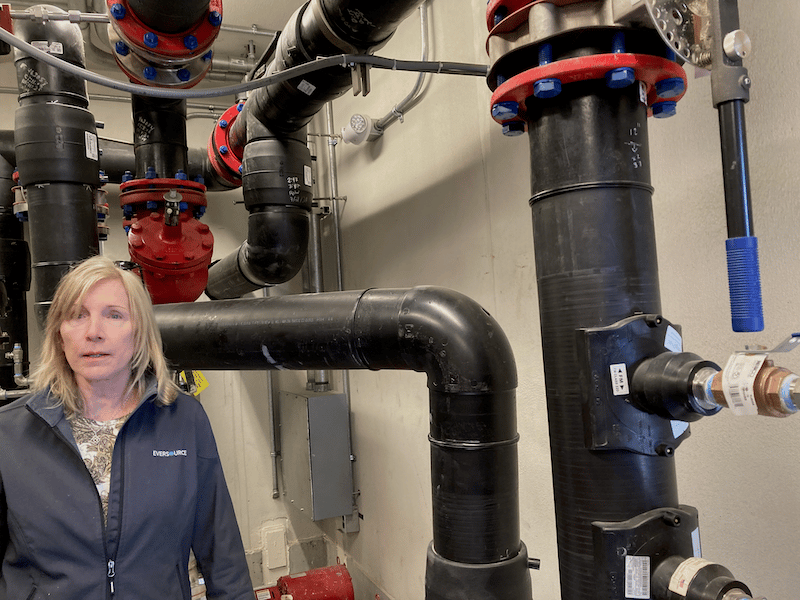
Clare Kirk of Eversource explains features of the geothermal pump house in a tour of phase 1 of the network.
Framingham’s geothermal network is officially set to double in size with an $8.6 million grant from the U.S. Department of Energy (DOE). The nonprofit HEET is the lead grant recipient in conjunction with Eversource and the City of Framingham. The funding will enable the addition of 140 new customers to the network as well as research to monitor the system’s performance.
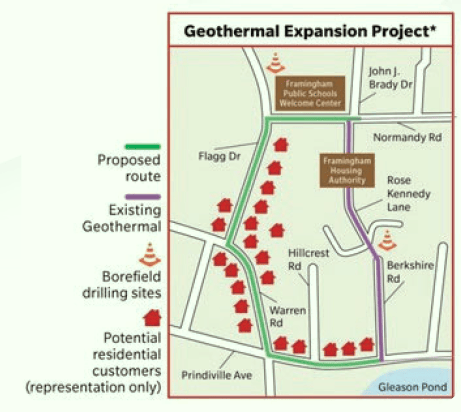
Courtesy City of Framingham/Eversource
The expansion will extend along Flagg Drive, Warren Road, and Normandy Road. Construction of the new network, planned to begin this year, and interconnecting it to the existing system is intended to demonstrate the growth and expansion potential of geothermal heating and cooling.
City Council to consider phasing out gas-powered yard equipment

In mid-December, two City Council subcommittees met to “discuss air and noise pollution and the current noise ordinance.” They were apparently prompted by a letter from Framingham resident Richard Lerner urging the city to phase out gasoline-powered lawn equipment, limit the hours when lawn equipment can be used, and ban use of leaf blowers off season. About a dozen communities in Eastern Massachusetts have passed similar ordinances according to information Lerner compiled.
Both subcommittees passed the same motion: that the next City Council take up the matter in early 2026, and prepare for a public hearing by gathering data and information from city departments.
Some pushback is anticipated, such as concerns about electric leaf blowers not being powerful enough, the inconvenience of having to recharge the equipment, the cost to landscapers having to buy new equipment, and the fact that Framingham already has a noise ordinance. (See this article for some reasons it has been hard for communities to ban gas-powered blowers.) On the flip side, proponents of bans cite concerns about pollution and carbon emissions from gas-powered equipment.
We’ll keep you posted about future hearing dates. In the meantime, if you’re considering purchasing electric lawn equipment, here are some helpful resources:
Mass Save rebates: Mass Save will give you $75 when you purchase an electric lawnmower or $30 for other electric lawn equipment.
Best electric leaf blowers from Wirecutter/New York Times.
5 Green Reasons to Choose Battery-Powered Lawn Tools from Consumer Reports.
How to Care for Electric Lawn Mower Batteries to Keep Them in Top Shape from Popular Mechanics.
Did you know?
Gas-powered yard equipment can put out 20 or more times the emissions of a car! According to Environment America, gas-powered lawn equipment emitted more than 30 million tons of carbon dioxide in 2020, equivalent to a year of carbon pollution from 6.6 million cars. Electric models are also up to 20 decibels quieter and require less maintenance.

BRIEFS
Time-limited offer: 20% off for new composting subscribers!

There’s no better time to start curbside composting with Black Earth Compost than right now.
Get 20 percent off your first Black Earth invoice by using the code “NEWYEAR2026.” Sign up by January 14 to get the discount.
The City Of Framingham is also providing 1 free starter kit (bin & liners) for new subscribers to Black Earth Compost, while supplies last.
Visit this City of Framingham webpage to learn more about the free starter kit program. Visit Black Earth Compost to sign up for service.
Cafeteria composting at Potter Road – volunteers needed!

Students in three grades at Potter Road Elementary School began separating food waste in the cafeteria last fall. Energize Framingham volunteer Ginny Doxey is helping the students on Mondays and Wednesdays; the food waste is then picked by Black Earth Compost. Potter Road Principal Alana Cyr wants to expand the effort and is seeking more volunteers on Tuesdays, Thursdays, and Fridays from 11:00 a.m.-12:30 p.m. Email [email protected] if interested.
Need advice on solar? Confused about Mass Save? The Home Modernization Navigator can help
Residents and property owners in Framingham have a new, free resource to help navigate the sometimes confusing set of programs, incentives, and financing available for energy upgrades, electrification, and energy efficiency improvements. Renters, homeowners, and rental property owners (1- to 4-unit buildings) are eligible and encouraged to participate in The Home Modernization Navigator (Español, Português).
The program, offered through the Massachusetts Clean Energy Center, provides one-on-one guidance around:
Clean electricity
Electrical upgrades
Energy bill savings
Heating and cooling, including solar installations
Appliances and yard equipment
Transportation (EV charging, e-bikes)
Weatherization
Framingham gets another air monitoring station
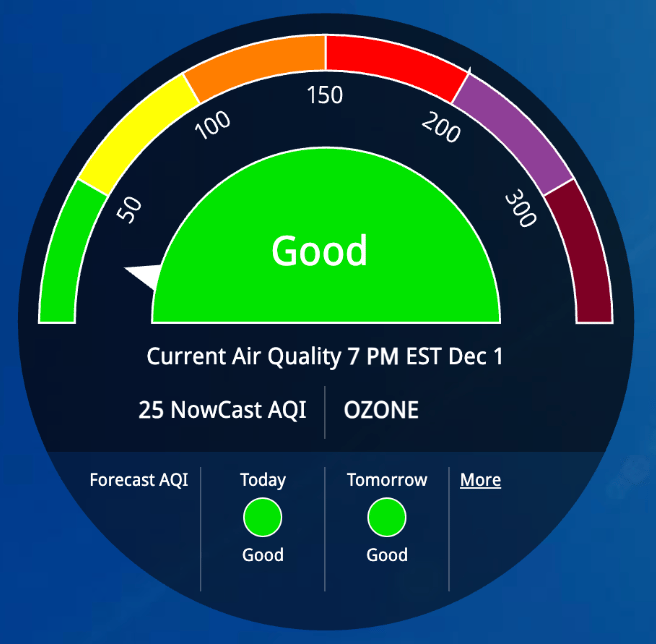
Source: AirNow.gov
The Massachusetts Department of Environmental Protection has announced the installation of two new air monitoring stations in Framingham and Saugus. Framingham’s is on Western Avenue, and joins four other existing sensors in the city. Each station measures pollution levels from fine particulate matter (PM2.5) and black carbon. All data collected are publicly accessible in real time through AirNow.gov. Data are also collected on the Fire and Smoke Map and the PurpleAir website.
Internship opportunity at Mass Energize
Our parent organization, MassEnergize, is partnering with the Massachusetts Clean Energy Center to offer a paid Climate Communications Associate internship for Spring 2026. They’re seeking a creative, mission-driven student with strong writing, visual, and social media skills to help expand their outreach, support the 2026 Community Climate Leaders Conference, develop multimedia content, and amplify community climate stories across Massachusetts.
Students who live in Massachusetts or attend a Massachusetts college are eligible to apply through the MassCEC Clean Energy Internship Program.
UPCOMING EVENTS
Stay updated about events by visiting www.energizeframingham.org/events. You can sign up for email notifications by creating a profile (“Sign In/Join” button on the top right corner on the page).
Tues. Jan. 13, 5-6 p.m. Native Plant Trust Webinar: Intro to Ecological Gardening for Birds (webinar)
Learn how native plants serve as the ecological cornerstone for the gardens of today and the future. REGISTER HERE FOR $10. This webinar is of a series of eight courses in the Introduction to Native Plants Package, and you can buy all of them at once for $60 here. Sponsored by Lexington Climate Action Network.
Thurs. Jan. 15, 5-6 p.m. Native Plant Trust Webinar: Intro to Understanding and Managing Soils (webinar)
Second in the above series.
Sun. Jan. 18, 1 p.m. Group hike: Greenways Conservation Land, Wayland
A relaxing 60- to 90-minute stroll through peaceful forests, open fields, and along a scenic boardwalk with expansive views of the Sudbury River. Paths are mostly wide and flat, making it a very accessible walk. Organized by Friends of Framingham Trails. Meet at the parking area, 22 Green Way, Wayland. Register (Note: at press time, this is linked to registration for the December hike, though it may be updated by now.)
Tues. Jan. 20, 7-8 p.m. Energy costs and strategies to reduce your bills (online)
Carrie Katan of the Green Energy Consumers Alliance will help us understand our utility bills, energy saving options from utilities, and energy efficiency actions to take in our households. Topics include:
How gas and electric costs are determined
Benefits of municipal aggregation (including low-cost options)
Issues with third-party electric suppliers
Other ways to reduce energy bills, including heat pump rates, Mass Save audits, low-income discount rates, and solar.
Register HERE.
Wed. Jan. 28, 7:15-8:15 p.m. (and beyond) Biosphere Book Club: Reflecting on Climate and the Natural World (online)
Is a River Alive? by Robert MacFarlane is the group’s first book. The first session will be online, with possible future in-person meetings. The group will explore a different book every two months, for six sessions per year. Sponsored by Energize Acton. Register HERE.
SAVE THE DATE!
Mass Energize Community Climate Leaders Annual Conference
Bentley University, Waltham
A dynamic, hands-on day of learning, connection, and climate leadership. Early Bird pricing ends Friday, Jan. 16!
IN THE NEWS
Framingham/Metrowest
Framingham City Council Approves Building Opt-In Code (The Frame)
The adoption of the code primes new buildings in the city to feature eco-friendly utility capacities starting in July 2026. Also covered by the MetroWest Daily News.
Rare Win for Renewable Energy: Trump Administration Funds Geothermal Network Expansion (Inside Climate News)
Framingham’s geothermal network is officially set to double in size with an $8.6 million grant from the U.S. Department of Energy. Geothermal technology has escaped the many cuts made by the DOE to renewable energy projects. See also coverage on The Frame,
Third annual Friends of Framingham Trails New Year's Eve celebration (Metrowest Daily News)
Photos capture the event.
Framingham City Council Rejects Special Permitting Authority Proposal (The Frame)
If approved, the motion would have made the City Council a group that could grant permits for larger-scale developments in the city spanning at least 125,000 square feet. It was rejected by a 5-5-1 vote. Those in favor believed it would give residents a direct connection for the planning of larger projects through their City Councilors. Opponents raised concerns about potential outsized influence of developers on City Councilors or councilors overstepping their authority. See also on Access Framingham (via YouTube).
Massachusetts/Region
Skyrocketing energy costs have shocked Massachusetts residents. Here’s what happened. (Boston Globe)
The reason for the extreme bills goes far beyond the base cost of the natural gas or electricity sent to our homes. Utilities have launched increasingly pricey infrastructure improvements that were rubber stamped by regulators (who recently moved to rein them after complaints from consumers). Some extra charges on utility bills, such as those for energy efficiency programs, save consumers in the long run. For every dollar spent on Mass Save, residents will receive $2.69 back in benefits, according to an analysis by the Acadia Center, a nonprofit focused on clean energy policy.
Why is it so cold? Some researchers say there may be a surprising culprit: climate change. (Boston Globe)
Instead of contradicting the reality of global warming, surges in Arctic air could be one of its strange new hallmarks. While New England winters are becoming undeniably shorter, milder, and less snowy, some research suggests that rapid warming in the Arctic can make the polar vortex, a mass of frigid air swirling above the North Pole, more likely to stretch down over North America. As climate change warms the Arctic, ice floating on the Arctic Ocean is disappearing, which may be causing the polar vortex to weaken or become elongated more often.
New Hampshire clean energy program goes national with federal funds (Canary Media)
In a rare federal win, Sen. Jeanne Shaheen secured $3M to expand the program, which helps towns and small businesses adopt clean energy and save money.
Some small climate and environmental solutions being developed in our backyard (Boston Globe)
From all-electric jet skis to trash-sorting AI bots, new products show the fun side of repairing the environment.
Good news you may have missed in 2025 (CBS News Sunday Morning)
This 7:34 segment kicks off with a focus on biodegradable “plastics” and Black Earth Compost.
NYC congestion pricing cuts air pollution by 22% in six months (Air Quality News)
In its first six months, New York City’s controversial congestion pricing scheme, introduced in January 2025, reduced air pollution by 22 percent in Manhattan’s toll zone, while improving air quality across the entire metropolitan region, according to a Cornell University study. In contrast, data from the Metropolitan Transit Authority (MTA), analyzed in The New York Times, showed no significant change in concentrations of vehicle-related air pollutants. However traffic jams are less severe, streets are safer, buses are faster, and commute times are improving one year after congestion pricing was enacted. The fees have generated hundreds of millions of dollars for public transportation projects.
Wind energy in jeopardy
Democratic Governors Are Fighting Trump’s War on Wind Energy (New York Times)
Leaders in Connecticut, Massachusetts, New York and Rhode Island are racing to save offshore wind farms targeted by the president. The developers of Revolution Wind off Rhode Island and Empire Wind in New York have sued the administration, as have developers of other projects off the New York coast. The Trump administration has cited unspecified national security concerns about the projects. Vineyard Wind for now is allowed to continue producing power.
National/General Interest
Power surge: law changes could soon bring balcony solar to millions across US (The Guardian)
When attached outside to a home’s balcony or patio, small plug-in solar panels can run appliances like fridges, dishwashers, and washing machines for free. They feed energy, via an inverter, into the wall socket and can be zip-tied in place without professional installation. Until now, state regulations have stymied balcony solar in the U.S. Bills filed in New York and Pennsylvania aim to change this, and Vermont, Maryland and New Hampshire are set to follow suit soon. Utah has already passed legislation allowing balcony solar.
Small plug-in solar panels gain traction as an affordable way to cut electricity bills (PBS News Hour)
‘A wolf in sheep’s clothing’: How the EPA is undermining children’s health (Boston Globe)
Gina McCarthy, former Environmental Protection Agency administrator and former White House climate adviser, argues that limiting chemical exposure to protect children is one of the White House’s four “Make America Healthy Again” priorities – yet the EPA’s actions are doing the opposite.
Why is it so hard to ban gas-powered leaf blowers? (Mother Jones)
Implementing the bans is proving more challenging than many expected. Many communities are frustrated that the new rules are not being properly enforced.
We discovered microbes in bark ‘eat’ climate gases. This will change the way we think about trees (The Conversation)
Researchers find that microbes in tree bark use gases like methane and carbon monoxide for energy and survival, and also remove hydrogen, which has a role in super-charging climate change.
Outcry Builds Over Trump’s Withdrawal From International Climate Treaties (Inside Climate News)
The moves, which face certain legal challenges and will take at least a year to execute, make the U.S. the only nation with no role in international negotiations to reduce pollution or aid poor nations bearing the brunt of climate impacts.
G.M. Books a $7.1 Billion Loss as It Scales Back E.V. Ambitions (New York Times)
General Motors is the latest automaker to announce a big loss from its investments in electric vehicles, facing a slump in sales of those cars after Congress and President Trump overhauled federal policy to favor fossil fuels.
Energy affordability
How energy affordability took center stage in 2025 (Canary Media)
Electricity bills have become a major driver of the cost of living crisis, with costs rising at more than twice the rate of inflation over the last year, largely because it’s expensive to maintain, expand, and repair aging utility infrastructure. More in this CNN article and multimedia explainer, which point to the costs of modernizing gas pipelines as the largest cost driver behind the emerging crisis. Various climate leaders weigh in.
Electricity Should Be Free at Noon (The Atlantic)
Leah Stokes, who works on energy, climate, and environmental politics at the University of California Santa Barbara, offers three ways policymakers can lower fast-rising electricity costs:
1) Make midday power cheaper, so people shift more electricity use toward the middle of the day, instead of later hours when prices are the highest and systems tend to rely on dirtier, more expensive energy sources.
2) Prevent utilities from passing new infrastructure costs on to consumers, which incentivizes building of infrastructure even if not needed. One solution is to have states build the transmission system instead.
3) Take the costs of hardening the grid against wildfires, heatwaves, ice storms, and hurricanes out of electricity bills.
Is the US headed toward an electricity crisis of its own making? (Canary Media)
Trump administration policies blocking clean energy and the energy needs of AI are fueling a growing mismatch between energy supply and demand.
AI data centers & energy costs
ABOUT US
Energize Framingham provides climate education, outreach, and advocacy to promote a healthy, equitable, and resilient community.
Have a tip for us? Email [email protected].
In case you missed it… Back issues!
Editors: Nancy Fliesler and Aimee Powelka
