- Energize Framingham
- Posts
- March 2026
March 2026

Your latest local news on sustainability and climate change action
Subscribe and never miss an issue!
IN THIS ISSUE
March 30: Urge the Mayor to fund a Chief Climate Officer
Coming soon: Smart electric meters
City committees align on climate and sustainability
Community electricity saves Framingham customers $1.6M
Public art project highlights energy-saving actions
State legislative update: Help preserve Mass Save!
Briefs: Walnut Street wetland project; geothermal expansion;
Eastleigh Farm update; spotting climate misinformation
Upcoming events | In the news
March 30: Urge the Mayor to add a Chief Climate Officer to the budget!

March 30 at 6 p.m. is the new scheduled date for Mayor Sisitsky’s public hearing on the operating budget. This is our chance to ensure that the Chief Climate and Sustainability Officer position, added by Framingham’s new city charter, is part of the budget.
While the position is supported by both the City Council’s Subcommittee on Environment and Sustainability and the Framingham Sustainability Committee, there is no guarantee it will be funded for FY2027. If the community doesn’t call for it, it will be easy for the Mayor to omit or defer it. There’s also a chance the city will try to merge it with the existing Sustainability Coordinator position, currently held by Shawn Luz,. We believe Framingham needs both positions.
At this writing, a draft operating budget for FY2027 has not yet been posted, but would be found on the city’s Budget Central page. After the public hearing, the Mayor will submit the budget to the City Council for approval. The Council will then likely refer it to the Finance Subcommittee , which will have 28 days to report back.
Please plan on attending the March 30 hearing! We especially encourage public comment. Please check the city Public Meeting Calendar to confirm the 6 p.m. time and location, and get the Zoom link if you cannot attend in person.
Some talking points:
Adding a Chief Climate Officer is an investment in Framingham’s future, and will help us prepare for, minimize, and mitigate climate impacts. For example, this officer could help create a financing path for solar installations, saving operating budget funds for years to come.
Framingham is on the verge of applying to the state for Climate Leader status, which could bring substantial grants to the city, helping to pay for the position. Moreover, the Chief Climate Officer would be key in getting additional grants, more than enough to cover their salary.
The current Sustainability Coordinator position has a limited scope, falling within the Capital Projects & Facilities Management department. In contrast, the Chief Climate Officer is an executive-level position reporting directly to the Mayor.
The Chief Climate Officer and would be empowered to work across all city departments, allowing climate and sustainability to be factored into all city decision making and long-range planning – land use, procurement, finance, building projects, transportation, and more.
The new officer would map out long-term capital improvement projects like adding solar panels to school and municipal properties, helping Framingham weather spiking energy prices.
At least six other Massachusetts cities already have a Chief Climate Officer or an independent climate or sustainability department, including Cambridge, Somerville, Medford, New Bedford, Newton, Boston, and Worcester.
In addition to attending the meeting, you can email the Mayor’s office directly at [email protected] or call 508-532-5401.
Smart electric meters: Designed for savings
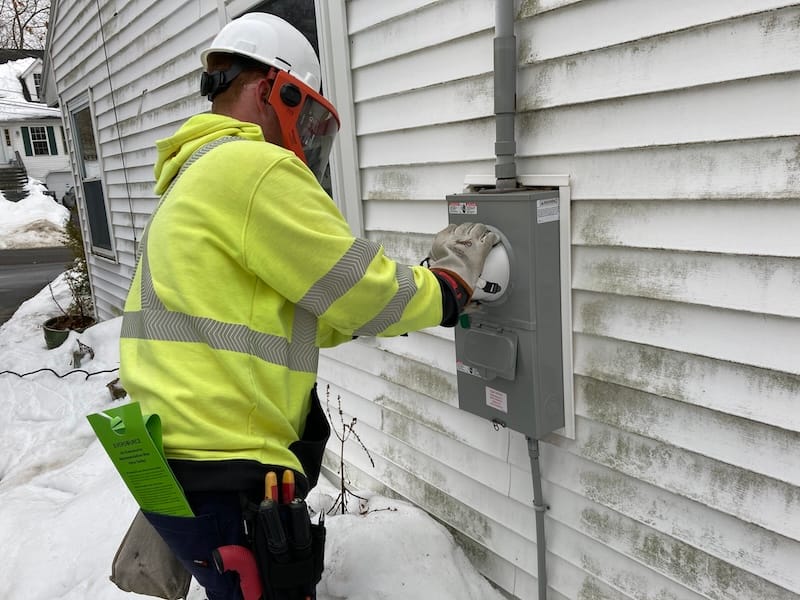
An Eversource representative installs an electric smart meter at a home in Framingham.
If you haven’t already, you may soon be getting a knock on your door from Eversource. The utility is installing smart electric meters in Framingham, Natick, and other Eastern Massachusetts locations.
Energize Framingham endorses smart meters! They reduce electricity costs for everyone by:
modernizing our electric grid to handle increasing numbers of solar panels, battery storage systems, and electric vehicle chargers
helping utilities better manage power by providing detailed real-time information on supply and demand
allowing utilities to adjust their pricing structures to charge lower electricity rates during off-peak hours
avoiding the need for utilities to use expensive, often polluting, backup power sources to meet peak demand. A study by the Department of Energy Resources indicates that load management tools, including those enabled by smart meters, could save up to $950 million in avoided electric system costs.
Smart meters also keep you informed about your own home’s energy use (online or via Eversource’s mobile app) and send you alerts when your electricity usage significantly exceeds your usual pattern. If your power goes out, the meters automatically notify Eversource so power can be restored more quickly.
If you’re a net meter customer, you will still receive a smart meter, but the net meter may need to be upgraded in tandem with your regular meter.
If you opt out of the new meter, Eversource will charge a $34 monthly fee to have your meter read manually.
Debunking safety concerns
Some unsubstantiated claims have been circulating about smart meters, based on the radiofrequency (RF) waves they give off. An email we saw for one webinar stated, “The science is very clear that the radiation pulsated 24x7 from these digital utility meters is a neurotoxin, carcinogen, causes infertility and more.”
While smart meters do use RF transmissions to talk to their central systems, so do other smart devices like cell phones, laptops, and WiFi routers. In fact, a 2019 study made measurements in homes and found that cell phones and other smart devices generate four times the power density of smart meters. Moreover, smart meters are located outside the home and transmit data only intermittently, about every 15 minutes, while cell phones and WiFi routers are indoors and emit RF radiation continuously.
According to the American Cancer Society, the amount of RF radiation you could be exposed to from a smart meter is much less than that from a cell phone, making it very unlikely that living in a house with a smart meter increases cancer risk. The World Health Organization and most public health agencies have concluded there are no established health effects from RF emissions from smart meters and or other smart devices.
City committees align on climate and sustainability
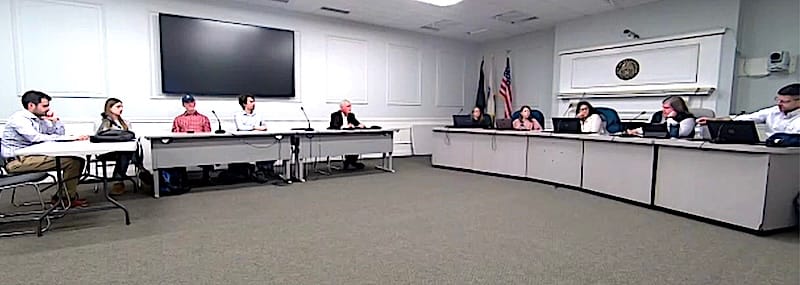
Energize Framingham listened in on a very encouraging meeting March 11 — a joint meeting of the Framingham Sustainability Committee, appointed by the Mayor and chaired by Erin Ellsworth, and the City Council’s Environment and Sustainability Subcommittee, chaired by Councilor Leora Mallach.
The two groups discussed collaborating to help meet Framingham climate and sustainability goals. As an all-volunteer group that’s sometimes had to swim against the current, Energize Framingham is excited to see two city government bodies aligned around a broad range of climate actions — from energy and building standards to open space and tree planting — and wanting to be proactive. We’re especially grateful to have allies in the City Council to guide projects like the Climate Action Plan and the Municipal Decarbonization Roadmap to fruition.
The two committees plan to stay in close touch and hold these joint meetings periodically. We look forward to working with both of them.
Framingham Community Electricity hits one-year mark

Framingham Community Electricity, the program in which the city purchases electricity in bulk, has saved residents and small businesses more than $1.6 million in its first year, according to a city press release. More than 17,000 Framingham homes and nearly 2,000 businesses have enrolled.
Launched in March 2025, the program offers three electricity supply options. Ninety-five percent of customers are enrolled in Framingham Standard Green, the default option which provides 35 percent of its electricity from renewable sources (higher than the current state requirement).
The remaining 5 percent chose to stay with Eversource Basic Service or opted for Framingham Basic, with the lowest rates, or Framingham Green Plus, which is more expensive but draws 100 percent of its electricity supply from renewable sources. Over the coming year, the Framingham Sustainability Committee plans an educational campaign to encourage opting into Green Plus.
It’s unclear what degree of savings Framingham Community Electricity will offer in the future, particularly with the currently volatile energy markets. Eversource’s rates for Basic Service are fixed only through July 31, 2026, while Framingham’s electricity aggregation contract is good until March 2027.
See FraminghamCommunityElectricity.com for more information, including current rates and program details.
Public art project highlights energy-saving actions

Images courtesy of the artists
Residents of Framingham and Natick are currently participating in a public art project called A Home for Our Future Generations, exploring how communities can act collectively to improve home energy efficiency. Funded by Mass Save’s Community First Partnership, the project features complementary outdoor installations in both towns, inviting residents to imagine a sustainable energy future through hands-on art while learning about Mass Save programs.
Each town will host an L-shaped installation composed of two 8 × 8 ft. walls featuring participants’ artwork. The interior walls will feature murals focused on energy conservation. The exterior will feature a mosaic of painted wood shingles highlighting savings through steps like insulation, window upgrades, heat pumps, efficient appliances, and solar energy.
Framingham’s installation will be located at the green space next to Village Hall on the Centre Common and will be unveiled this spring. Community art-making workshops began this month in Framingham and Natick. The next workshop is March 27 at 1 p.m. (see Upcoming Events below).
A Home for Our Future Generations is led by Julia Csekö and Raquel Fornasaro, award-winning Brazilian-American visual artists and educators committed to socially engaged, community-centered public art. The project aims to engage at least 2,050 participants — echoing Massachusetts’ 2050 goal to decarbonize buildings and homes.
State legislative update: Help preserve Mass Save!
The House Ways and Means Committee has passed a redraft of H.4744, “An Act Relative to Energy Affordability, Clean Power and Economic Competitiveness.” Now called H.5151, the bill is headed to the Senate.
H.5151 is a mix of good and bad. The most concerning part of the bill is a proposed one billion dollar cut to Mass Save, reducing Mass Save’s funding for late 2026 and 2027 by 40 to 50 percent.
We oppose this funding cut because:
It makes it harder for consumers to access better insulation, weather sealing, and energy efficient equipment like heat pumps, solar panels, and batteries to lower their household energy costs.
It makes it harder for consumers to decrease their carbon footprint, endangering the state’s climate goals.
It’s a missed opportunity to reduce electricity demand, which will alleviate pressure on the electrical grid and save money in the long term.
We encourage you to reach out to State Senator Karen Spilka and ask that funding for Mass Save be restored in the Senate’s version of the bill. Since the bill will then go to a House/Senate conference committee, we urge you to contact your State Representative as well.
On the good side, the revised bill would:
protect consumers from overcharging by third-party electric suppliers by empowering municipalities to ban them;
prevent data centers from increasing communities’ electricity bills and require them to procure clean energy for their power needs;
encourage expansion of solar panels by streamlining permitting, allowing towns to have more net-metered solar, and consumers to install plug-in balcony solar;
enhance clean energy availability by enabling the Department of Energy Resources to sign long-term contracts for renewable energy credits from clean energy projects.
If you want to see Mass Save preserved, here are the action steps you can take:
Locate your State Representative’s contact information here. Sen. Karen Spilka’s contact information here.
Call the number (you will speak to a staff member or be directed to voicemail) or send an email.
Suggested script: "Hi, my name is...... and I live in ....... and I am calling because I am concerned about cuts to Mass Save in H. 5151. This program is necessary to meet Massachusetts’ climate goals and benefits everyone in the state by lowering utility bills, reducing electricity use, and reducing the need for costly grid expansion.”
BRIEFS
Walnut Street wetland project progressing

Work is progressing on the path that runs from Walnut Street, which runs alongside Bowditch Field, to Stonybrook Drive near Fuller Middle School. The path and the Walnut Street neighborhood have been prone to substantial flooding. Funded by FEMA and the Massachusetts Municipal Vulnerability program, the project aims to restore the natural wetland, clear obstructions to water flow, and add a boardwalk so people can enjoy the area. More background in our June 2022 newsletter.
Geothermal expansion update
It’s happening! According to Framingham Sustainability Coordinator Shawn Luz, the Phase 1 project is now largely complete outside of a little work in a couple homes, and monitoring underway. Phase 2 will establish a new loop to expand down Flagg Drive, Warren Road, and the rest of Rose Kennedy Lane, and tie in the rest of the Farley school administration building. In addition, project sponsors Eversource and HEET are planning a study with the National Guard headquarters which also wants to join the project. Construction, including building conversions, is likely to start at the end of this year and continue until Oct 2027, Luz says.
Eastleigh Farm reduces its funding request
In a bid to save Eastleigh Farm from developers, the farm’s owners had originally asked the Community Preservation Committee to put $3 million of its funds toward purchase of the land as an agricultural restriction. That request has now been reduced to $1.2 million to help keep the application alive and enable preservation of 80 of the farm’s 112 acres. The CPC will finalize its funding recommendations after a public hearing on March 23. Learn more from The Frame.
Help strengthen regional bus transit with your comments
The MetroWest Regional Transit Authority (MWRTA) has opened the second public comment period for its ongoing Bus Network Redesign project. You can submit comments through March 31, 2026.
Public input will help guide the final redesign and support the goal of building a stronger, more connected transit network for Framingham and MetroWest.
Visit www.mwrta.com/Redesign to learn more about the project.
Use the interactive map to view Draft #2 of the proposed routes and submit comments directly.
Spotting climate misinformation
Have you ever seen a post claiming heat pumps are “a scam” or that EVs are worse for the environment than gas cars? This helpful article from Mass Energize gives pointers and further resources on how to tell true and false or misleading claims apart and distinguish real climate actions from “greenwashing.”
Seen a misleading climate claim? Send it to us at [email protected].
UPCOMING EVENTS
Thurs., Mar. 19, 7 p.m.: From Gas to Induction: Cleaner Cooking for Your Home (webinar)
Induction is faster, more responsive, safer, and eliminates harmful pollutants linked to asthma.
Thurs., Mar. 19, 7-8:30 p.m. The Truth About Rare Earth Elements Mining with Dr. Jeremy Williams (online)
Rare earth materials play a crucial role in solar panels and electric vehicles, essential for electrification and decarbonization. But where are the rare earth materials coming from, and what is the impact? Register for Zoom link.
Sat., Mar 21, 10 a.m.-5 p.m. The Gardener’s Gathering
Northeastern University, Curry Center
This free in-person gardening conference brings Boston-area growers of all kinds together for a full day of informative workshops, engaging exhibitors, networking, and inspiration.
Sun., Mar. 22, 2 p.m. Group walk” Cushing Memorial Park/Farm Pond
A 1-2 hour stroll around Cushing Park and, conditions permitting, the The Farm Pond trail. Sponsored by Friends of Framingham Trails. Parking Lot at 80 Dudley Road. Register
Mon., Mar. 23, 7 p.m. Community Preservation Committee Public Hearing
The Committee will finalize its recommendations for projects to fund. Check the city Public Meeting Calendar for location and Zoom link.
Wed., Mar. 25, 7-8:15 p.m. Biosphere Book Club (online)
Abundance by Ezra Klein and Derek Thompson will be discussed.
Wed., Mar. 25, 7-8:30 p.m. SuAsCo Climate Collaborative Community Meeting
Harvey Wheeler Community Center (Council on Aging)
1276 Main Street, West Concord
Residents, municipal partners, and community-based organizations from across the Sudbury, Assabet, and Concord Rivers (SuAsCo) watershed are invited to discuss shared climate resilience priorities and opportunities for regional collaboration.
Thurs., Mar. 26, 1-2:30 p.m. Author and Activist Gerry McGovern discusses his latest book, 99th Day: A Warning About Technology
Our current ways of life are unsustainable, and we are already living with the consequences. Gerry McGovern’s book examines how we got here and what we can do for future generations. In his words, “we must protect and resist.”
Fri. Mar. 27, 1 p.m. Community Art Project: A Home For Our Future Generations Framingham Public Library, 49 Lexington Street, Costin Room
Using wood shingles and art supplies, participants of all ages and skill levels are invited to design a shingle that will become part of the exterior of our outdoor sculpture. See story above for more on this public art project. Registration requested.
Mon., Mar. 30, 6 p.m. Mayor’s public hearing on FY 2027 budget
Blumer Room, Memorial Building. Check the City’s Public Meeting Calendar to confirm, and for the Zoom link if you cannot attend in person.
Wed., Apr. 8, 8 a.m.-5 p.m. 2026 MassEnergize Climate Leaders Conference
Bentley University, Waltham
A full-day gathering of 250+ climate leaders from across Massachusetts. Attend dynamic sessions, learn practical tools, and network with organizers, municipal staff, students, advocates, and others committed to accelerating local climate solutions. Register and pay
Thurs., Apr. 9, 8 a.m.-12 p.m. MassEnergize Post-Conference Deep Dive Workshop: Social Media & Outreach in Action
Bentley University, Waltham ($85 if attending the MassEnergize Climate Leaders Conference above)
Wed., Apr. 22, 7 p.m. Heat Pumps 101: Great Heat and Cooling, New Incentives (Webinar)
Get heat and AC all in one, new heat pump electric rates lower operating costs.
Sat., Apr. 25, 11 a.m.- 3 p.m. EARTH DAY
Framingham Centre Common (at Edgell Road/Vernon Street).
Stop by Energize Framingham’s table!
Rain date May 2, 11 a.m. - 3 p.m.
SAVE THE DATES
May 1 through September 1: Art on the Cochituate Rail Trail
The trail will transform into an open-air gallery featuring eight unique installations by talented local artists.
Sat., May 30, 10 a.m.-12 p.m. Cooler Communities Fair
Students are using design thinking to tackle the question: How do we shrink our carbon footprint?
Thurs., Jun. 18, 3-7 p.m. Framingham Farmer’s Market opens
Framingham Centre Common, Edgell Road and Oak Street.
The market will take place weekly through early October 2026. Apply to be a vendor.
IN THE NEWS
Framingham/Metrowest
Framingham ZBA finds housing proposal ineligible for Dover Amendment (Metrowest Daily News)
The Zoning Board of Appeals, voting 3-0, found that the project is not essential for educational purposes as the developers argued. The vote overruled Building Commissioner Fred Bray’s decision last fall to exempt it from most local zoning regulations.
$3M Eastleigh Farm Community Preservation Act Plan Outlined (The Frame, 2/19/26)
New Eastleigh Farm CPA Request Calls for $1.25M (The Frame, 3/11/26)
The Community Preservation Committee reviewed an updated funding request form Eastleigh Farm, which has been reduced from $3 to 1.25 million to increase its chance of passage. The committee’s final review of all CPC projects is at a public hearing March 23. See also The Frame’s video coverage (jump to 2:03).
Why Framingham MA remains wary about development in Nobscot section (MetroWest Daily News)
A proposed 416-unit housing development on a 31-acre parcel in Framingham's Nobscot neighborhood has drawn concerns about the project's scale, traffic impact, and density.
Massachusetts/Region
House passes landmark energy bill with deep cuts to Mass Save, sending it to Senate (CommonWealth Beacon)
Seeking to rein in consumer energy bills, House lawmakers voted 128-27 to approve a H.5151, a bill that cuts $1 billion from the energy efficiency program Mass Save, which ratepayers pay for on their utility bills. Other H.5151 provisions would speed solar permitting and strengthen protections for many electricity consumers. Also covered by the Boston Globe, State House News Service, and WBUR. (See our coverage above.)
After year of skyrocketing utility bills, Eversource reports skyrocketing profits (WCVB)
The company posted earnings of $1.69 billion for 2025, more than double the $812 million earned in 2024.
Did you get a ‘discount’ on your recent utility bills? Here’s what it means. (Boston Globe)
You might see a cut in electricity and gas costs, but most of it must be paid back. The winter bill relief extends through March.
2025 was a tough year for climate progress in Mass., though there were some bright spots (WBUR)
The Healey administration’s annual climate report card for 2025 shows mixed results. Electric vehicle adoption was weaker than expected, but heat pump installations were higher than expected. Other wins included Hydro Quebec and Vineyard Wind, now sending power to the grid. The state also met its target for land protection and made progress on tree planting. Rollbacks in federal funding have slowed progress overall. More in the Commonwealth Beacon and the Boston Globe.
Did climate change contribute to the record-setting New England blizzard? (Boston Globe)
It’s too soon to say, according to experts.
Vineyard Wind, country's first large-scale offshore wind project, finishes construction (WBUR)
After years of starts and stops, workers installed the final blades on the last turbine to complete Vineyard Wind off the Massachusetts coast.
New England’s biggest grid battery is up and running in Maine (Canary Media)
A massive new battery has entered service in southern Maine, boosting the Northeast’s efforts to expand renewable energy through energy storage. By 2030, Massachusetts aims to have 5 gigawatts of energy storage, Connecticut 1 gigawatt, and Maine 400 megawatts. New Englands’s other large battery installation, the Cranberry Point Energy Storage project, came online in Massachusetts last June.
Can a big battery help Boston save billions on the power grid? Maybe. (Canary Media)
The U.S. desperately needs to make more room on its electricity grid. The Trimount battery project, taking shape in Everett, could help make the case for an alternative to expanding the grid: big, strategically placed batteries. The installation would be one of the largest in the nation.
In Western Mass., environmentalists fear that solar farms are fire hazards (Boston Globe)
A wave of solar proposals in the Hilltowns are facing pushback from residents who worry that the attached batteries will start fires and pollute their water. No fires have been recorded among the approximately 6,000 batteries connected to the electrical grid in Massachusetts, according to a state official.
Hydropower Line From Quebec to Queens Could Power a Million N.Y.C. Homes (New York Times)
A 339-mile buried transmission line, known as the Champlain Hudson Power Express, is on schedule to bring clean electricity to New York City this spring.
National/General Interest
Energy costs
As Iran war shakes energy system, some see powerful argument for renewable energy (Associated Press)
The Iran war and its costly energy crunch have some experts wondering if they will boost support for homegrown renewables over imported fossil fuels. But others note this didn’t pan out after Russia’s invasion of Ukraine.
Climate funding
States push climate superfund bills despite Trump’s opposition (Canary Media)
The bills would make oil and gas firms pay for climate damage from burning their products, repaying states for past recovery efforts and covering future resilience projects. (A White House executive order last year compared these efforts to extortion, and the EPA recently repealed the scientific finding that greenhouse gases are a harm to public health and welfare.)
Billions in Climate Grants, Frozen for a Year, Are Back in Court (New York Times)
A year after the Trump administration blocked money that Congress had awarded for clean energy projects, the legal fight rages on.
Supreme Court agrees to hear case on Colorado dispute over climate change (SCOTUSblog)
Colorado contends that oil and gas companies have knowingly fueled climate change and caused millions of dollars of damage to its property and residents.
Solar
U.S. Solar Installations Fell in 2025 as Trump Attacked Clean Energy (New York Times)
More solar energy was added to U.S. grids than any other technology, but the amount installed fell by 14 percent, says a new report. However, battery storage installations increased to their highest annual level.
Balcony solar is taking state legislatures by storm (Canary Media)
In more than half of U.S. states, including Massachusetts, Republican and Democratic lawmakers have introduced legislation that would boost adoption of DIY solar systems. Virginia is the second state to allow it.
Easy-to-use solar panels are coming, but utilities are trying to delay them (NPR)
State lawmakers are proposing bills that eliminate complicated utility connection agreements, which most utilities say should be required for plug-in solar too.
Solar power’s newest friends: MAGA influencers (Politico)
The nation’s leading clean energy lobby aims to bolster solar power’s standing via conservative media partnerships.
Electric vehicles
How long do electric vehicle batteries actually last? (NPR)
Drivers have worried that EVs would need expensive battery replacements within a few years. But battery lifespans are exceeding expectations. "These 2, 3, 4-year-old off-lease cars that are coming back have battery health scores well upwards of 95%,” said one dealer.
Trump’s EPA is yanking support for electric school buses (Canary Media)
There’s $2.3 billion left unspent from a Biden-era clean school bus program. The Trump admin wants more of it to go to buses that run on fuels like diesel and not batteries.
ABOUT US
Energize Framingham provides climate education, outreach, and advocacy to promote a healthy, equitable, and resilient community.
Have a tip for us? Email [email protected].
Editors: Nancy Fliesler and Aimee Powelka
